Marbella Hill Club: a buyer’s guide to the inner Golden Mile
Summary
Discover Marbella Hill Club, a prestigious gated community on the Golden Mile. Offering a unique blend of sea and mountain views, large plots, and a mature residential setting, it’s ideal for those seeking privacy and proximity to Marbella’s finest amenities.
Key Takeaways
- Marbella Hill Club is a mature, gated villa community on the Golden Mile, known for its irreplaceable position, mature plots, and security.
- Key features include its prime location near Marbella town and Puerto Banús, stunning sea and mountain views, a residential scale with large plots, and diverse villa styles.
- The community offers excellent accessibility to amenities, schools, and natural surroundings, with its location providing a unique balance between privacy and convenience.
Marbella Hill Club has been one of the most consistently requested addresses on the Golden Mile for more than three decades. A gated villa community set against the foothills of La Concha, ten minutes' drive from Marbella town centre, five minutes from Puerto Banús, and yet, from inside the gates, a different country altogether. The headline numbers (irreplaceable position, mature plots, security, proximity to everything) explain part of why Hill Club holds its position. The rest takes longer to explain, and that's what this guide is for.
This is a working guide for buyers who are about to look at Marbella Hill Club seriously, or who are already comparing it with the other gated villa communities of the Golden Mile. It covers what the urbanisation actually is, how it compares with the neighbouring gated communities of the inner Golden Mile, what living here looks like, what the villas cost, and what tends to go wrong for buyers who skip the local knowledge.

What is Marbella Hill Club
Marbella Hill Club is a gated villa community set on the hillside at the foothills of Sierra Blanca and La Concha, on the upper section of Marbella's Golden Mile. The urbanisation is composed predominantly of individual villas on generous plots, alongside a smaller number of townhouses (at Marbella Hill Village) and the distinctive apartment-and-penthouse community of Jardines Colgantes, all integrated within the wider gated address. There are no high-rise buildings inside the gates, and the architectural character is overwhelmingly residential rather than developmental. The community has 24-hour security at the entrance, mature gardens throughout, and direct access to the protected green belt at the base of the Sierra Blanca Mountains.
Four features define what it actually means to live at Marbella Hill Club:
The location is one of the most sought-after on the entire Costa del Sol. Ten minutes by car to Marbella town centre, five minutes to Puerto Banús, fifteen minutes' walk from Puente Romano and the beach, surrounded by the most prestigious addresses of the inner Golden Mile (Sierra Blanca, Cascada de Camoján, Altos Reales, Nagüeles). Few other communities sit this close to everything Marbella offers while still feeling genuinely tucked away in nature.
The setting is what truly sets it apart. The urbanisation is positioned at the foothills of La Concha, with the protected green belt of the Sierra Blanca Mountains rising directly behind it. From inside the community, the views are dramatic in two directions: south over the Mediterranean as far as the African coast on clear days, and north onto the rock face of La Concha itself. Few addresses on the Costa del Sol offer that combination of sea views, mountain backdrop and direct access to nature.
The scale is residential, not commercial. Marbella Hill Club is composed of individual villas on substantial plots, separated by mature gardens and quiet leafy streets. Plot sizes typically run from 1,000 to over 3,000 square metres. There are no hotel-style amenity buildings, no large communal pools, no shared facilities at scale. Each property is a self-contained home, and the community functions as a residential neighbourhood rather than as a managed resort.
The villas are exceptionally varied in style and vintage. The community was developed over several decades, with the earliest villas dating from the 1980s and 1990s, and a steady stream of new builds and full renovations continuing to the present day. As of mid-2026, a typical four to five-bedroom villa at Marbella Hill Club runs from around 400 to 800 square metres of built area on a plot of 1,000 to 2,000 square metres, with private pool, garden, garage and outdoor entertaining areas. The newer and more renovated villas reach 1,000 square metres of built area or more, often with home cinema, gym, spa, wine cellar and staff quarters. That variety in product is one of the community's most useful features, and it means the price range inside the gates is genuinely wide.
The community has matured over thirty years into the kind of residential setting that newer developments simply cannot replicate. The plot proportions, the mature landscaping, the quiet streets, the established neighbourly relationships, none of this is buildable in a single development cycle. That maturity is one of the structural reasons Marbella Hill Club has held its position over the years.
What changes the conversation for most buyers at Marbella Hill Club isn't the moment they walk in, but the moment they walk out. You step from the kitchen or the living room onto the terrace, look one way and see the Mediterranean unfolding all the way to the African coast, look the other and find La Concha standing immediately above the house. The garden continues down towards the pool, the pine canopy filters the afternoon light, and a property you've just been viewing as a series of rooms suddenly reveals itself as a property that lives outside as much as inside. That dual orientation, sea in front and mountain behind, isn't something other Golden Mile addresses can claim in the same way, and it's typically what shifts a buyer from interested to committed.
Where is Marbella Hill Club located
Marbella Hill Club sits on the inner Golden Mile, in the upper section of the hillside between the N-340 coastal road and the Sierra Blanca Mountains, in the municipality of Marbella. To the south, the Mediterranean and the beach, about ten minutes by car. To the north, La Concha mountain rising directly behind the community. To the east, Marbella town centre, around ten minutes away. To the west, Nueva Andalucía and Puerto Banús, also five to ten minutes away.
Marbella Hill Club is reached from the N-340 by taking one of the upper Golden Mile exits and climbing the road that leads towards Sierra Blanca and the Sierra mountains. The community is clearly signposted, with its controlled gated entrance. From Marbella town centre, it is about 10 minutes by car. From Málaga airport, around 40 minutes via the AP-7.
The drive times from Marbella Hill Club are one of the community's most concrete selling arguments. Roughly:
- Puente Romano and the beach, 5 minutes
- Puerto Banús, 5 to 10 minutes
- Marbella town centre and Old Town, 10 minutes
- San Pedro de Alcántara, 15 minutes
- Nueva Andalucía Golf Valley, 10 minutes
- Málaga airport, 40 minutes via the AP-7
- Gibraltar airport, around an hour via the AP-7
Unlike addresses higher up the mountain or further inland, at Marbella Hill Club you don't depend on the car for everything. From the lower edge of the community you can walk down to Puente Romano and the beachfront in about fifteen minutes, with most of the descent on quiet roads or footpaths. Several of the international schools, particularly Swans International, are within walking or short driving distance. It is a gated community, but it is not an isolated one.
The traffic on the Golden Mile is the only real complaint I hear from my Marbella Hill Club clients. In peak season, July and August, the N-340 between Marbella and Puerto Banús becomes dense at certain hours, and the climbs back up to the urbanisation can take longer than usual. If your way of living involves multiple daily trips down to the coast, it's worth checking the actual times at different moments before committing to a specific villa.

Marbella Hill Club compared with the neighbouring gated communities
Most buyers who consider Marbella Hill Club seriously are also looking at Sierra Blanca, Cascada de Camoján and Altos Reales. These four communities form the cluster of established gated villa addresses on the inner Golden Mile, and a serious buyer typically visits at least two or three before deciding. The differences between them are real, but they're not always obvious from a brochure, and most listings treat them as interchangeable. They aren't. This is the comparison I have with my own clients in the first conversation.
Sierra Blanca is the largest, the best-known and the most internationally branded of the four. Often referred to as the "Beverly Hills of Marbella," it occupies a substantial elevated position above the Golden Mile with a structured grid of wide avenues and three controlled entrance points. Plots range widely, from compact villa lots of around 1,000 square metres to estates of 5,000 square metres or more. The architectural mix is broad, from classic Andalusian villas of the 1990s to the most recent contemporary mansions, with a particular concentration of high-end new builds and full rebuilds. Prices currently range from around €2 million for the smaller or unrenovated properties to over €25 to €30 million for the most exceptional new builds, with an average villa price around €6 to €7 million. Sierra Blanca is bigger in scale, more international in profile, more visible as an address, and generally at a higher entry price than Marbella Hill Club. Buyers who prioritise the international brand recognition, the structured layout and the largest concentration of contemporary new-build supply lean towards Sierra Blanca.
Cascada de Camoján is the smallest, the most discreet, and arguably the most exclusive of the four. Tucked into the foothills of La Concha directly above Sierra Blanca, the community is known for its very large plots (typically 2,000 to over 10,000 square metres), its dense pine woodlands and its borders with the protected natural reserve behind. The architectural style is overwhelmingly contemporary, with most properties built or rebuilt in the past fifteen years. Prices currently range from around €1.5 million for the rare smaller property to €15 million or more for the most exceptional contemporary villas, with the median villa price around €10 to €11 million. Cascada is at a higher price per square metre than Marbella Hill Club, with fewer properties on the market at any given time, and a generally higher level of architectural ambition. Buyers who prioritise the ultra-private setting, the largest plot sizes and contemporary architecture lean towards Cascada de Camoján.
Altos Reales sits to the east of Sierra Blanca, slightly closer to Marbella town, and offers a more mature villa community with strong security and a quieter profile than the better-known addresses. Plot sizes are generally substantial, the villa stock mixes 1990s Andalusian properties with more recent renovations and new builds, and the community has held its position as a discreet but desirable address among long-term Marbella owners. Prices typically run from around €3 million for the older properties to €14 million or more for the most ambitious new builds. Altos Reales is more discreet than Sierra Blanca, less contemporary than Cascada, and generally similar to Marbella Hill Club in price range and product variety. Buyers who want a quieter, less publicly known address with similar quality and proximity often consider Altos Reales alongside Hill Club.
Marbella Hill Club's position in this group is genuine and distinctive. It is more discreet than Sierra Blanca, more architecturally varied than Cascada de Camoján, and broader in product range than Altos Reales. The variety of vintages and renovation levels at Hill Club is the widest of the four, which means it offers the broadest range of entry prices, from accessible older properties suitable for renovation through to top-end new builds that compete directly with anything in Sierra Blanca or Cascada. The mature setting, the proximity to the protected green belt at the back of the community, and the walking-distance proximity to Puente Romano are arguments that none of the other three can fully match.
Which is the right answer depends entirely on what the buyer is looking for. There is no objectively better community among the four; there is only the better fit. The buyers who do best at Marbella Hill Club are typically those who have visited at least one of the other three first, understand what makes each different, and choose Hill Club because of what it offers specifically rather than by default. The buyers who choose Sierra Blanca or Cascada do so for the same reasons in reverse. All four are legitimate top-tier answers; the wrong move is to pick without comparing.
The history of Marbella Hill Club
The first villas of Marbella Hill Club were developed in the late 1980s, as the Golden Mile started to expand inland from the original Marbella Club and Puente Romano nuclei. The community grew gradually over the following decades, with successive waves of construction reflecting the architectural conventions of each period. The classic Andalusian and Mediterranean villas of the 1990s and early 2000s still form part of the housing stock, alongside the cleaner contemporary builds of the past ten years and the most recent generation of architect-designed new builds, which now compete directly with the very top of the new-build market on the entire coast.
Two things have remained constant across that thirty-year span. First, the plot sizes. The community was conceived from the start as a low-density villa neighbourhood, with substantial plots separated by mature landscaping, and that low density has been preserved rather than compromised over time. Plot sizes of 1,000 to 3,000 square metres are the rule rather than the exception, and that scale is one of the structural reasons the community still feels generous despite three decades of development. Second, the security and administration model. Marbella Hill Club has operated with controlled access and 24-hour security throughout its life, and the community has been administered consistently by professional firms. That continuity protects the resident experience in a way that newer or less consolidated addresses cannot easily match.
What has changed, and changed meaningfully over the past ten years, is the level of investment in individual villas. Where the community used to offer a fairly homogeneous product of substantial-but-traditional villas, today it presents a much wider range. Original-condition villas from the 1990s sit alongside fully renovated period properties, contemporary rebuilds and brand-new architect-designed villas at the top end of the market. The result is a community where the price range from entry-level renovation project to top of market is genuinely wide, and where the work the previous owner has put into the property matters as much as the address itself.
The reputational position of the community has also shifted upwards in the past decade. As prices on the Golden Mile have moved consistently higher, and as new-build supply has become scarce at the top end, the established gated villa communities of the inner Golden Mile have consolidated their position as the most desirable addresses in Marbella. Marbella Hill Club sits firmly within that category, and the trend has only deepened since 2021.
The villas and architecture within Marbella Hill Club
Marbella Hill Club is not divided into named sub-areas the way Nueva Andalucía is. The differences here come down to plot size, position within the community, orientation, and above all the vintage and condition of the individual villa.
A note worth making before going further. The community is composed predominantly of detached villas on individual plots, alongside the townhouse development of Marbella Hill Village and the architecturally distinctive Jardines Colgantes, an apartment-and-penthouse community of generous units with substantial private terraces, and private pools on the penthouse units, terraced into the hillside in one of the most elevated positions within Marbella Hill Club. Plot sizes for the villas typically run from 1,000 square metres at the lower end to over 3,000 square metres for the most generous positions. Built areas typically run from 400 to over 1,000 square metres depending on the vintage and the scale of any renovation.
The earliest villas at Marbella Hill Club, from the late 1980s and 1990s, are mostly in the classic Andalusian and Mediterranean style typical of the Marbella of that era. Pitched terracotta roofs, white walls, generous arched openings, mature gardens. Many of these villas have been substantially updated by their owners over the years, but a meaningful share still trade in original or partially renovated condition, and they represent the lower entry point into the community. For buyers who see value in renovating, or in tearing down and rebuilding, these properties offer the best ratio between price and position.
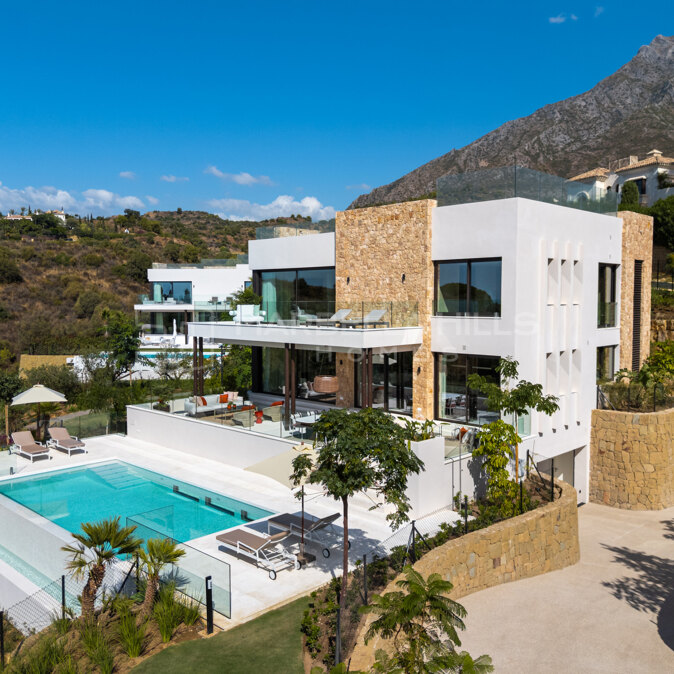
The more recent villas, from the 2010s onwards, reflect the shift towards contemporary architecture that has reshaped the top of the Marbella market. Clean lines, large glazed openings designed around the views, open-plan layouts, integrated technology, full home wellness facilities. Many of these properties were built or rebuilt specifically to meet the standards of today's international buyer, and they consistently command a premium for that reason.
But the most important distinction within Marbella Hill Club isn't the vintage. It's the position within the community. Villas on the upper streets, closer to La Concha, generally have the best mountain backdrop and the most open sea views. Villas on the lower streets sit closer to the Golden Mile services and the walk down to Puente Romano. Plots on the southern flank typically have the best sun exposure throughout the day. Plots on the eastern edge can have privileged views over Marbella town. Each position has its own logic, and the right one depends entirely on how the buyer intends to live in the property.
Which villa is the right one for you depends entirely on how you want to live in it. I have sold villas across every vintage and every position within the community. The conversation about which one fits usually only becomes clear after the first visit in person. What's certain is that the listing photographs won't tell you the real differences between two properties at the same price in different positions of the urbanisation.

Living at Marbella Hill Club
Daily life at Marbella Hill Club has a quality that buyers find hard to describe before they have spent time here, and obvious once they have. The villa, the plot, the mature gardens, all of these matter, but what shapes a day at Hill Club is the relationship between the property and where it sits. Five minutes down to Puente Romano and the beach. Ten minutes east to Marbella Old Town. Five to ten minutes west to Puerto Banús. Whatever you want from the day, the city, the sea, the restaurants, the tennis courts at Puente Romano, the route up La Concha behind the house, all of it is within easy reach without you ever feeling that you live in the middle of it. That is the actual experience of the address, and it is what owners come to value most after the first year.
What makes Marbella Hill Club work as a primary residence is something villa owners on the coast understand once they have lived it. A villa on a substantial plot, behind your own walls, with mature gardens, a private pool and the maturity of trees that have been growing for thirty years. You don't share a corridor with anyone. You don't hear a neighbour's pool pump or a stranger's terrace conversation. The dog goes out by itself. Friends arrive at your gate. Children grow up using the whole plot as their territory. This is what living in a villa actually means, and Hill Club delivers it with the added security of the perimeter gate and the proximity to everything Marbella offers, which most isolated villa estates further inland simply cannot match.
Buyers who come to Marbella Hill Club from villa estates further inland, or from the more exposed beachfront positions of the Golden Mile, usually notice the same thing within their first weeks. The lifestyle is calmer, less performative, more genuinely residential. There are no tourists wandering past the gates. There is no street noise from the seafront promenade. The community is largely composed of long-term owners who use the property as a primary or near-primary residence, and that changes everything about how a day unfolds.
The microclimate is one of the community's quietly important features. The elevation, around 150 to 250 metres above sea level, makes summer nights noticeably cooler than at the beachfront. The terraces and gardens remain usable late into the evening throughout July and August, which is genuinely difficult on the seafront. In winter, the protection of the mountains behind blocks the colder winds from the north, and the south-facing aspects of most plots capture the sun for most of the day. Many owners use their outdoor spaces eight to ten months a year as their main living area.
Day to day, living at Marbella Hill Club means using a property that was designed to be lived in fully. Substantial interior spaces. Multiple terraces. Private pool and gardens. Direct access to nature through the green belt behind the community. For buyers who use the property as a primary residence, this combination of scale, privacy and proximity is what tends to convince them.
For buyers who used to own larger estates in the country and want to combine privacy with proximity to amenities, Marbella Hill Club often becomes the answer. For families with children at the international schools of the area, the community offers gated security, generous outdoor space and a school run that rarely exceeds fifteen minutes. For buyers looking for a primary or near-primary residence within easy reach of everything Marbella offers, the address consistently delivers. The community doesn't favour one buyer profile over another, and that diversity is part of what has protected its market depth over the years.
The community at Marbella Hill Club
Marbella Hill Club isn't a community in the sense of a village. It's a low-density residential neighbourhood of detached villas, with the social dynamics that come with that. There's no central plaza inside the gates, no clubhouse café, no shared communal pool where everyone meets by accident. But there is a community, and it works in a way that's worth understanding before you buy here.
What defines the community at Marbella Hill Club is the stability and quality of its resident base. Many owners have been here for ten, fifteen, even twenty years. Turnover is slow, and when properties do change hands, they often transition between owners with very similar profiles: international, established, long-term oriented. The community is largely composed of people who chose Hill Club deliberately, often after considering Sierra Blanca, Cascada de Camoján and other inner Golden Mile addresses, and who stayed because the choice continued to work for them.
The community functions socially through the surrounding infrastructure rather than through any shared internal space. The Puente Romano Tennis Club, the restaurants of Puente Romano and the lower Golden Mile, the international schools, and the more informal meeting points along the Old Town and Marina Banús form the social map of most Marbella Hill Club residents. Friendships form gradually, often through the school run, through tennis and padel at Puente Romano, through running into neighbours at the restaurants, through community-wide events organised by the administration.
Equally, you can be entirely private at Marbella Hill Club without it being unusual. The plot sizes are large enough that most villas don't have direct visual contact with their neighbours. The streets are quiet, with little through traffic. The community structure allows for whatever degree of social interaction the owner wants, and nothing more. For buyers who value their own space but want the security and infrastructure of a gated community, this balance is one of Hill Club's quiet strengths.
The international mix at Marbella Hill Club is genuine and balanced. Spanish, British, Scandinavian, German, Belgian, Dutch, Middle Eastern and increasingly American owners are all part of the community. English functions as the most common second language, but Spanish is widely spoken and useful for daily life, particularly when dealing with the gardeners, the security team and the community administration.
Marbella Hill Club isn't a community for people who want constant social activity organised around them. It works best for people who want the security, the privacy and the location of a serious gated address, and who set the temperature of their own social life. For the right buyer, that's exactly the balance they were looking for.

The views from Marbella Hill Club
The views are what most listings of Marbella Hill Club reduce to a single phrase about "sea views and La Concha." The reality is more interesting, and more variable, than that.
Marbella Hill Club sits at the foothills of Sierra Blanca, with the rock face of La Concha rising directly behind it. The views from most positions within the community work in two directions. To the south, the Mediterranean and the African coast on clear days, with the Golden Mile and Puente Romano laid out in the middle distance. To the north, La Concha itself, dominating the entire skyline. Some plots have both views from the same property, depending on how the villa is positioned within the plot. Most have a meaningful version of one or the other, and the best plots within the community make full use of both.
South-facing villas have the panoramic sea view, the all-day sun, and the long evenings outdoors. These are the plots the market values most consistently, and the plots that hold their value best over time. When clients ask me which orientation to prioritise, the honest answer is almost always south-facing if the budget allows it.
Upper-position villas, closer to the back of the community against the mountains, have the most dramatic La Concha backdrop and tend to be the most private. The sea view is still present but the immediate sensation is of being tucked into the foothills. For buyers who want the maximum sense of privacy and connection to nature, these positions are often the right answer.
Plots with a fully open sea horizon, unobstructed by the villa or vegetation in front, are the most consistently sought-after at Marbella Hill Club. These are not the cheapest plots in the community, and they command a premium for good reason. When the south-facing orientation combines with an unobstructed view corridor and a generous plot, you have what the market considers the prime category within the community, and the resale dynamics reflect that.
The night view from Marbella Hill Club is one of the underrated features of the community. The lights of the Golden Mile, Puerto Banús and Marbella stretch below in a continuous arc. On clear nights, you can see the lights of Gibraltar to the west and the African coast across the Strait. The elevation puts the community above most of the light pollution of the coast, and the sky directly overhead remains relatively dark. Several clients have told me that the night view is what they ended up loving most after a year of living here.
A practical note for buyers. The views from inside Marbella Hill Club vary significantly from one plot to the next. Always visit the specific villa at the time of day you most want to use the outdoor space. The view at 11am is not the view at 7pm, and the view in February is not the view in August. Take the time.

Schools and family life at Marbella Hill Club
Marbella Hill Club is one of the most practical addresses on the Golden Mile for families with school-age children. The location does most of the work, and the configuration of the community supports family living naturally.
The international schools that families on the Golden Mile use most are all within an easy drive from Marbella Hill Club. Swans International School is roughly 5 minutes away, and a meaningful share of Hill Club residents have children there. Aloha College in Nueva Andalucía is about 10 minutes. The English International College is roughly 10 to 15 minutes. The British School of Marbella (BSM), Laude San Pedro and Sotogrande International School are all within a reasonable drive for the families that have chosen them. For families whose children attend any of these, Hill Club sits at the centre of the school map rather than at the edge of it. For a fuller overview of the schools available to international families on the Costa del Sol, see our guide to the top international schools in Marbella.
Day to day for families, Marbella Hill Club works exceptionally well. The school run is short. The plots are large enough for children to play outdoors, swim, ride bikes and have friends over without the constraints of a smaller property. The 24-hour security and the absence of through traffic inside the community mean children can move around the streets relatively freely. The proximity to Puente Romano and the Marbella Tennis Club gives families access to tennis, padel, swimming and other family-friendly amenities within five minutes of the gates.
For families coming from northern European cities, the combination of outdoor space, climate, security and school proximity is often the deciding factor. Marbella Hill Club is a community where children spend most of the year outdoors, where families can host gatherings with ease, and where the daily logistics of school, shopping and activities are simpler than in almost any comparable position on the coast.
The honest note for families. Marbella Hill Club is a villa community, which means there are no shared family amenities inside the gates. Each property functions on its own. Families looking for a more shared family environment, with communal pools, playgrounds and shared common areas, might find their needs better met in some of the apartment communities on the Golden Mile. But for families who want the privacy and space of a villa, with the security of a gated community and the proximity to schools and amenities of the inner Golden Mile, Hill Club is one of the strongest answers on the entire coast.
Health and wellness at Marbella Hill Club
The day-to-day health and wellness infrastructure around Marbella Hill Club is among the strongest of any address on the Golden Mile. The location helps, and the proximity to the major hotels and clubs of the Golden Mile means that almost any wellness or fitness service is within five to ten minutes of the gates.
The natural environment around Marbella Hill Club invites an active lifestyle in a way that few other addresses on the coast can match. The protected green belt of the Sierra Blanca Mountains behind the community has marked hiking and walking trails, including the well-known route up La Concha itself. Cycling routes through the upper Golden Mile and into Ojén and the Sierra de las Nieves are accessible directly from the urbanisation. Within the villas themselves, many of the larger and more recent properties include private gyms, saunas, indoor pools and full wellness facilities, reducing the need to leave the property for routine fitness.

For organised fitness and spa services, the Puente Romano Tennis Club is around 5 minutes away and operates one of the most established tennis academies on the coast, alongside a wide range of fitness and wellness services. The Marbella Club, Puente Romano and Anantara Villa Padierna spas are all accessible by membership or per-visit basis. The Six Senses Spa at the Marbella Club is widely considered one of the best wellness destinations on the coast.
For private healthcare, Hospital Quirónsalud Marbella is around 10 minutes east via the A-7. Hospital USP Marbella is closer still. Helicópteros Sanitarios… covers the area without issue. The drive to a hospital is short enough that it's rarely a deciding factor for buyers at Marbella Hill Club, which compares favourably with more isolated addresses. For a fuller look at the public and private healthcare options available in Marbella, see our guide to healthcare in Marbella.
The wellness culture in this part of the Golden Mile is well developed. Pilates studios, yoga centres, personal trainers, physiotherapists, nutrition clinics, all within five to ten minutes of the community. For owners who want a comprehensive wellness routine without leaving the area, the infrastructure is genuinely there.
La Concha and the protected nature behind Marbella Hill Club
One of the genuinely distinctive features of Marbella Hill Club is what sits behind it. The community backs onto the protected green belt of the Sierra Blanca foothills, with La Concha, the iconic 1,215-metre peak that gives Marbella its mountain skyline, rising directly above. No other gated community on the Golden Mile has that same direct relationship with the protected nature behind the coast.
In practice, that translates into something most coastal addresses cannot offer: nature on your doorstep without having to drive to find it. Walking and running trails wind through the pine forests and limestone slopes immediately behind the community. The Sierra Blanca foothills are home to wild olive groves, Aleppo pines, Mediterranean shrubs, and the occasional cabra montés (Iberian ibex) higher up. The morning light filters through the canopy in a way that the front of the Golden Mile, with its denser urban grain, simply does not.
For more ambitious walkers, the full ascent to the summit of La Concha is one of the great hikes of the Costa del Sol. The main route starts from the Refugio de Juanar, near the village of Ojén, about a 20-minute drive from Hill Club, and takes most hikers 5 to 6 hours round trip with around 900 metres of ascent. The summit views, the Mediterranean on one side, Gibraltar and the African coast to the south, the Serranía de Ronda inland, are among the most spectacular on the entire Costa del Sol. A secondary route, El Mirador, starts closer to the Marbella Club Golf Resort and offers a shorter but steeper approach for experienced walkers. Many Hill Club residents incorporate at least the easier sections of these trails into their weekly routine, and a meaningful share have made the full ascent multiple times.
The protected status of the green belt matters for property values as well as for lifestyle. Behind the community, there is no development potential, no future construction that could compromise the views or the silence. The mountain is not a backdrop, it is a permanent border, and a permanent guarantee. That kind of structural protection is something newer developments further along the coast simply cannot replicate, because the land behind them is, in most cases, still developable.
For buyers who value the proximity to Marbella's amenities but who also want the option of stepping into protected nature without leaving the address, Marbella Hill Club is one of the very few answers on the entire coast.

Restaurants and daily life at Marbella Hill Club
The restaurant situation around Marbella Hill Club is one of the genuine advantages of the location. Within five to ten minutes by car you have access to one of the densest concentrations of high-quality restaurants on the entire Costa del Sol.
Five minutes down to Puente Romano opens up some of the most established restaurants on the coast: the iconic Dani García group of restaurants, Nobu Marbella, Sea Grill, Cipriani, and a long list of others within the resort and along the lower Golden Mile. The Puente Romano Tennis Club restaurant itself is a regular meeting point for the community.
Ten minutes east takes you to Marbella Old Town and the historic centre. The renovated streets of the Casco Antiguo are home to dozens of restaurants ranging from traditional Andalusian to international, from casual tapas to formal dining. The Plaza de los Naranjos and the surrounding streets form the cultural and social heart of Marbella, and they are accessible from Marbella Hill Club within ten minutes.
Five to ten minutes west takes you to Puerto Banús, with its own restaurant scene more oriented to international and luxury dining. For nights when that is what you want, it's a short drive. For nights when it isn't, the quieter restaurants of San Pedro Old Town or the inland village of Benahavís are both within easy reach.
For everyday provisions, the supermarkets of the Golden Mile are five minutes by car. El Corte Inglés in Puerto Banús for fuller shopping. The local markets of Marbella town for fresh produce. The pharmacy and post office network is dense and walkable across the lower Golden Mile. Marbella Hill Club's location makes the daily logistics simpler than at almost any other elevated address on the coast.
What stands out for buyers who move to Marbella Hill Club is how little they end up needing to drive for the everyday. They keep the car for the airport, for longer excursions, for trips into the Sierra de Ronda. For the daily rhythm (restaurants, sports, shopping, the school run) much of it happens within a few kilometres of the gates. That density of useful proximity is one of the genuine luxuries of the address.
Walking distance to the beach from Marbella Hill Club
There is one daily ritual at Marbella Hill Club that sets the community apart from every other gated villa address on the inner Golden Mile, and most buyers don't realise it until they have spent a weekend here. You can walk down to Puente Romano. From the lower edge of the community, a 15 to 20-minute walk on quiet residential streets and the lower section of the Golden Mile takes you directly to the Puente Romano resort, the beach promenade and the row of restaurants between Marbella Club and the Marbella Tennis Club. The walk is gentle, mostly downhill, shaded for much of the year, and uses the kind of routes that locals know rather than the main N-340.
Sierra Blanca is also elevated above the Golden Mile, but the descent is steeper and the walk less practical. Cascada de Camoján sits higher still, and reaching the beach on foot from there is not a routine activity. Altos Reales is at a similar elevation to Marbella Hill Club but further from the most useful coastal points, with no comparable walking route to Puente Romano or the Marbella Club. Within the inner Golden Mile cluster, Marbella Hill Club is the community where walking to the beach is actually built into the daily rhythm of life.
In practice, this means a number of things that buyers value once they have lived them. The morning walk down to Puente Romano for breakfast or coffee, before the day starts in earnest. The early evening walk down for an aperitivo at one of the restaurants, returning by taxi when dinner runs late. The Sunday brunch routine that doesn't require driving or parking. For families, the option of letting older children walk down to the beach on their own during the summer, with the security of knowing the route is residential the whole way.
The walk back uphill is, of course, a different proposition. Most residents are honest about taking a taxi or an Uber on the return leg, particularly in July and August when the afternoon heat makes the climb less appealing. But the downhill route is what matters for the daily lifestyle, and it is one of the genuinely under-marketed features of the address.
For buyers comparing Marbella Hill Club with the alternatives, this walking proximity to the lower Golden Mile is one of the arguments that consistently shifts the decision in Hill Club's favour. Not because every owner walks every day, but because the option is there, and because the address feels integrated with the wider life of Marbella in a way that more isolated communities cannot match.
Security at Marbella Hill Club
Security at Marbella Hill Club is one of the questions buyers ask me most often, particularly those moving from northern Europe or from urban environments where they've become accustomed to a certain level of personal security infrastructure. I want to answer this properly, because it's one of the genuine reasons buyers select Hill Club over more open addresses.
The community is fully gated, with 24-hour manned security at the main entrance. Every vehicle is logged. Visitors require prior confirmation by a resident. Delivery drivers, contractors, gardeners and domestic staff are pre-registered with the community. The security team knows the residents, knows the cars, knows the routines. That kind of consistent, low-friction control is the difference between security as marketing and security as actual practice.
There is no through traffic inside the community. The internal roads of Marbella Hill Club lead only to its own villas. Nobody drives through the community on their way somewhere else. Every vehicle inside the gates is either a resident, a registered visitor, or a registered service provider. That model genuinely changes the security profile of the address compared with non-gated streets on the lower Golden Mile.
Each villa within Marbella Hill Club typically has its own additional security on top of the community perimeter. Most properties have their own perimeter walls, electric gates, alarm systems, CCTV, and many of the higher-end villas have full integrated security systems with connection to private security services. The layering of community perimeter, plot perimeter and home security is what most professional security consultants recommend, and Hill Club residents typically have all three.
One of the underrated security features at Marbella Hill Club is the stability of the resident base. People know each other. Cars are familiar. New faces are noticed. That low-level community awareness is something no professional security company can manufacture, and it contributes meaningfully to the actual safety of the community over time.
Honest comparison with other Golden Mile addresses. Sierra Blanca has similar perimeter security but is larger and busier. Cascada de Camoján has very strict access control on a smaller scale and is one of the most secure addresses on the coast at the high end. The non-gated villa streets of the Golden Mile, even the most prestigious ones, do not offer the same security profile. Marbella Hill Club's particular strength is the combination of consistent perimeter security, low community density, and the kind of resident stability that makes the security model self-reinforcing.
A practical recommendation. If security is a primary reason you're considering Marbella Hill Club, visit the community at different times of day and at least once after dark. Watch how the security team works at the entrance. Notice the patrols inside. Pay attention to how visitors are processed. The quality of a security operation is visible to anyone who watches it for ten or fifteen minutes, and the security at Hill Club holds up to that kind of attention.

Properties at Marbella Hill Club
The architectural identity of Marbella Hill Club has evolved meaningfully across the three decades of its development. The earlier villas, built between the late 1980s and the early 2000s, reflect the architectural conventions of their era. Mediterranean-style architecture, white walls, terracotta roofs, generous arched openings, mature gardens. Many of these original villas have since been substantially updated by their owners, often to standards that match anything being built today. A meaningful share, however, still trade in original or partially renovated condition, and they represent the most accessible entry point into the community for buyers willing to renovate.
The villas built from the mid-2010s onwards represent a clear architectural progression. Cleaner contemporary lines, larger glazed openings designed around the views, more open layouts, full integrated home technology, full home wellness facilities (gym, spa, sauna, indoor pool), substantial outdoor entertaining areas, and a level of finish that competes with the very top of the new-build market on the coast. The most recent generation of architect-designed new builds at Marbella Hill Club has reached price points that compete with Sierra Blanca and Cascada de Camoján at the very top end of the inner Golden Mile market.
What's consistent across every generation of villa at Marbella Hill Club is the generosity of plots and built areas. A typical four-bedroom villa at Hill Club is rarely under 400 square metres of built area on a plot of at least 1,000 square metres. Five and six-bedroom villas typically run 600 to over 1,000 square metres of built area on plots of 1,500 to 3,000 square metres or more. The largest villas at Hill Club, particularly those built or renovated to top-end specifications, can reach 1,500 square metres or more of built area on plots that exceed 3,000 square metres. By the standards of contemporary villa developments on the coast, where smaller plot sizes have become the norm, the plot proportions at Hill Club feel exceptional.
What's also consistent is the relationship between the villa and the plot. Most villas at Marbella Hill Club are positioned to maximise privacy, sun exposure and view corridor, with mature gardens occupying a substantial share of the plot. Private pools are standard, and the most established properties have generous outdoor entertaining areas, covered terraces, garages and staff accommodation as part of the integrated design.
Pricing varies widely across the community, depending on size, vintage, position, condition and view. As of mid-2026, four-bedroom villas at Marbella Hill Club in original or partially renovated condition typically range from around €3.5 million to €5.5 million. Fully renovated four to five-bedroom villas range from €5.5 million to €9 million. Newly built or fully rebuilt architect-designed villas with premium specifications range from €8 million to €15 million, with the very top of the market reaching €20 million or more for the most exceptional positions and the largest properties. Townhouses at Marbella Hill Village range from €1.3 million to €2.5 million. Apartments and penthouses at Jardines Colgantes typically range from around €1.5 million for smaller units to €4 million or more for the most renovated penthouses, particularly those with private pools on the rooftop terraces.
These villas currently for sale illustrate where that top tier sits today: a contemporary designer villa on a 3,301 m² plot near the Golden Mile (ref. MH9056) at €13,500,000, and two sea-view designer estates of similar scale at €14,995,000, one designed around the views on a 3,560 m² plot (ref. MH8723) and one architectural villa with especially generous terraces (ref. MH8722). You can see the current selection of villas for sale in Marbella Hill Club here.
Property types in Marbella Hill Club
The property mix at Marbella Hill Club is narrower than at mixed-use addresses elsewhere on the Golden Mile. The community was conceived as a villa neighbourhood, and that focus has held. What there is, instead, is a well-defined range of categories.
Detached villas form the dominant category. Four to six-bedroom layouts predominate, with a smaller number of larger seven and eight-bedroom villas at the top end of the market. The defining feature is the plot. Even the smaller villas at Marbella Hill Club sit on plots that are generous by the standards of newer developments, and the larger villas occupy plots that simply cannot be replicated in any contemporary development. Detached villas at Hill Club typically range from around €3.5 million for older, partially renovated four-bedroom properties to €20 million or more for the most ambitious recent rebuilds.

Townhouses form a smaller but established category, primarily concentrated at Marbella Hill Village, a small private development within the wider Marbella Hill Club community. These properties offer a more manageable scale than the larger villas, with shared community facilities and a more turnkey lifestyle, while still benefiting from the location and the security model of Hill Club. Townhouses typically range from €1.3 million to €2.5 million depending on size and condition.

Apartments and penthouses at Jardines Colgantes form a distinctive third category that deserves its own treatment. Jardines Colgantes ("hanging gardens" in Spanish) is one of the most architecturally distinctive apartment communities anywhere on the Golden Mile. Built in Moorish-Andalusian style, terraced into the hillside on one of the most elevated positions within Marbella Hill Club, the development is composed of generously sized apartments, duplexes and penthouses, each with substantial private terraces and panoramic views over the Mediterranean and La Concha. The penthouses are the most distinctive product within the community, typically featuring private swimming pools on the rooftop terrace (a feature rarely found in apartment communities on the coast) alongside generous indoor-outdoor flow and the best view corridors in the development. Apartments and duplexes throughout the community share the same terraced architecture, the same panoramic position and access to the lushly landscaped gardens that give the urbanisation its name. Apartments typically run from 200 to over 400 square metres of built area, with terraces of 100 to 200 square metres or more on the duplexes and penthouses. As of mid-2026, two-bedroom apartments typically range from around €1.5 million to €2.5 million depending on condition, position and floor. Renovated three to four-bedroom duplexes and penthouses range from €2.5 million to €4 million, with the most exceptional fully renovated penthouses with private rooftop pools and prime view corridors reaching higher. For buyers who want the Marbella Hill Club address and lifestyle, with the security, the views, the gardens and the position, but without the maintenance demands of a full villa, Jardines Colgantes is one of the most distinctive answers anywhere on the Golden Mile.

Plots and rebuild projects form a separate sub-category. Several of the older villas at Marbella Hill Club, particularly those in partially renovated or unmaintained condition, are bought as rebuild projects, with the new owner either fully renovating or, more commonly today, demolishing and rebuilding to contemporary standards. Plots within Hill Club are increasingly rare and command premium prices, with values typically reflecting the build potential of the position.
The honest practical note across all categories is the same. Two properties of the same nominal type and size can be very different homes depending on the plot, the position, the vintage of the construction, and the level of renovation. I've sold villas of comparable size where the price difference between two listings was over €3 million, and the price difference reflected real differences in plot quality, position, view corridor and renovation that no listing photographs could fully communicate. The first conversation with any serious buyer is about understanding these distinctions before we even walk into the first property.
Renovating or rebuilding at Marbella Hill Club
Buying an older villa at Marbella Hill Club and either fully renovating or rebuilding it is one of the most reliable value strategies in the Golden Mile market, but it requires understanding what the process actually involves before you commit.
Most buyers who renovate or rebuild at Marbella Hill Club significantly underestimate how long the process takes, and not because the construction itself is slow. The works themselves typically run 12 to 18 months for a full renovation and 24 to 36 months for a complete rebuild, in line with any high-end villa project on the Costa del Sol. What buyers don't anticipate is everything that happens before the first wall comes down: the architect briefs, the technical surveys, the structural studies, the licence submission to Marbella town hall, the inevitable rounds of clarification, and the coordination between architect, project manager, structural engineer and interior designer. That phase alone often takes six to twelve months for an ambitious project, and it happens before any visible progress on the villa itself. The buyers who arrive at Hill Club expecting to start works the month after completion are the same buyers who feel frustrated a year later when they are still in design and permits. The buyers who plan for a full two-year horizon from purchase to finished home, and treat the design and permit phase as part of the process rather than as preliminaries to it, are the ones who experience the work as a managed project rather than as a slow-motion problem.
Marbella town hall takes architectural and planning compliance seriously. Any renovation that affects the building envelope, the volumes, the footprint or the external appearance requires formal licence approval before work can start. Full rebuilds require comprehensive planning approval. The architects who work regularly at Marbella Hill Club know the rules and can navigate the planning process competently. The ones who don't can lose six months to a year on submissions that get rejected or need revision.
Renovation and rebuild costs are meaningful figures. For a full renovation of a Marbella Hill Club villa to current contemporary standards, budget €2,500 to €4,000 per built square metre for the works themselves, before furnishing. For a full rebuild to top contemporary specifications, budget €3,500 to €6,000 per built square metre. For a 600-square-metre villa, that places the renovation budget in the €1.5 to €2.5 million range and the rebuild budget in the €2 to €3.5 million range. Premium specifications (high-end kitchens, full home automation, integrated wellness facilities, designer interiors, custom carpentry, top-tier landscaping) push that higher. The best architects and contractors on the coast charge premium rates, and those rates reflect the level of work delivered.
The local team makes or breaks the project. Architect, project manager, contractor, interior designer, landscape designer. The good professionals on the Golden Mile know Marbella Hill Club well, have worked through the Marbella town hall process many times, and have established relationships with the local trades. Trying to manage a Hill Club renovation or rebuild remotely, or with a team that doesn't know Marbella, is the most common reason projects here run over budget and over time. I can introduce buyers to teams I've seen deliver multiple successful projects at Hill Club on time and on budget. That introduction alone often saves more than its weight in actual euros.
A well-executed renovation or rebuild almost always recovers its cost. Buyers who renovate or rebuild a Marbella Hill Club villa carefully end up with a property that fits them, fits the community, and resells exceptionally well when the time comes. Original-condition villas sell at meaningful discounts to renovated ones, and the work cost is typically more than recovered on resale once the project is complete. For buyers with the patience, the budget and the right team, this is one of the most reliable value strategies in the entire Marbella market.
The honest caveat. Renovating or rebuilding a villa isn't for everyone. It requires substantial patience, tolerance for project management, the willingness to make thousands of small decisions over a period of years, and the ability to absorb timeline and budget overruns. Buyers who want a finished product on the day they collect the keys should buy a recently renovated or recently built villa and skip the construction process entirely. Both routes work. The choice depends entirely on temperament, timeline and budget.

A few personal takes about Marbella Hill Club
What I tell my own friends when they ask about Marbella Hill Club.
If you want the absolute prime position on the inner Golden Mile, with proximity to everything Marbella offers and the kind of mountain setting that nothing on the beachfront can match, Marbella Hill Club is one of the best answers on the entire coast.
If you want a villa with substantial plot, mature gardens and full privacy, in a gated community with consistent security and a stable resident base, Marbella Hill Club's product is genuinely difficult to match in any newer development.
If you're choosing between Marbella Hill Club and Sierra Blanca, both are excellent. Sierra Blanca is generally more expensive, more international in profile, more contemporary in average vintage. Hill Club is slightly more discreet, often slightly better value at comparable specification, and arguably more closely connected to the protected nature behind. Either can be the right answer; the choice usually comes down to specific properties rather than the abstract comparison.
If you're choosing between Marbella Hill Club and Cascada de Camoján, Cascada is smaller, more contemporary, more architecturally homogeneous, and generally at a higher entry price point. Hill Club has more variety, more vintage range, and more flexibility on entry price. Buyers looking for contemporary new-build in a small ultra-private community lean towards Cascada; buyers looking for established mature setting with the option to renovate lean towards Hill Club.
If you want a property you can rent reliably when not in residence, Marbella Hill Club is suitable but it's not a community structured around rental. Most owners use the property as a primary or near-primary residence, and the rental market here is more for established long-term tenants than for short-term holiday lets. The community administration takes a measured view on rental activity, in line with most prestige villa communities on the Golden Mile.
Where to buy within Marbella Hill Club
Not all positions within Marbella Hill Club are equivalent. The plot matters. The position within the community matters. The orientation matters. The view corridor matters. The vintage matters. The level of renovation matters. Two villas of identical nominal size in the same community can have meaningfully different prices because of where and how they sit.
The plots on the southern flank of the community, with full open sea views, are the most valued category. These positions catch the sun throughout the day, have unobstructed view corridors, and command the highest prices both at acquisition and at resale. When a south-facing plot with a clean view corridor comes to market in Marbella Hill Club, it tends to attract serious attention quickly.
The plots on the upper streets, closer to the back of the community against the mountains, offer the most dramatic La Concha backdrop and the deepest sense of privacy. These positions are particularly attractive to buyers who want the mountain setting as the primary experience rather than the sea view, and they have their own committed market.
Plot size matters more than buyers initially expect. The smaller plots at Marbella Hill Club (1,000 to 1,500 square metres) are still substantial by current development standards, but the larger plots (over 2,000 square metres) deliver a noticeably different experience in terms of privacy, garden scale and visual separation from neighbours. The price premium for a larger plot at Hill Club is real and well established.
The vintage and condition of the villa matters as much as the plot. A 1990s villa in original condition, on a good plot, is often priced significantly below a fully renovated or newly built villa on a comparable plot, even though the underlying position is similar. For buyers willing to take on a renovation or rebuild, this gap is where the most reliable value strategies in the community live. For buyers who want move-in ready, the fully renovated and newly built villas command premium prices that are justified by the work and finish delivered.
The right villa at Marbella Hill Club usually only becomes obvious after seeing several properties in person. The differences between listings are real, and they are difficult to convey in photographs. Ten minutes inside a south-facing renovated villa on a 2,000-square-metre plot versus ten minutes inside an older property on a 1,000-square-metre plot at the back of the community will tell you more than any amount of paperwork. The first visit is what makes the choice real.

The cost of owning at Marbella Hill Club
Ownership costs at Marbella Hill Club break down into the standard categories for a Spanish luxury villa: local property tax (IBI), refuse collection, community fees, insurance and operating costs. For non-resident owners, an additional annual income tax (IRNR) applies. The figures scale meaningfully with the size and value of the villa, and they are higher than for an apartment in a similar location, simply because the property itself is larger and more complex to maintain.
The structural costs at Marbella Hill Club are what you'd expect for a serious gated villa community on the Golden Mile:
- IBI (the Spanish equivalent of council tax) for a Marbella Hill Club villa typically runs €4,000 to €15,000 per year, depending on the catastral value, the size of the villa and the plot. The newest and largest villas at the top of the market can run higher. This is a meaningful figure but consistent with comparable addresses on the Golden Mile.
- Refuse collection (tasa de basura) in the municipality of Marbella runs approximately €250 to €500 per year for a villa, depending on the rateable value.
- Community fees at Marbella Hill Club are moderate compared with full-service resort communities, because the community model is residential rather than amenity-based. Typical community fees range from €200 to €600 per month, primarily covering security, road maintenance, street lighting, common landscaping and administration. There are no shared pools or shared amenity buildings to maintain at the community level, which keeps fees lower than at some apartment communities of comparable status.
Operating costs at the villa level are where most of the running cost actually lives, and they depend almost entirely on how the property is used and maintained:
- Utilities (electricity, water, gas): a Marbella Hill Club villa in full-time use typically runs €500 to €1,500 per month, with the pool, air conditioning and irrigation forming the largest cost categories. Larger villas with full wellness facilities (indoor pool, spa, sauna) can run higher. Occasional-use owners typically see lower monthly figures but proportionally higher costs per month of actual use.
- Insurance (building and contents): a comprehensive policy for a Marbella Hill Club villa typically runs €2,000 to €6,000 per year, depending on the value of the property and contents. Specific clauses for art, jewellery, classic cars or premium fittings push it higher.
- Gardening and pool maintenance: a Marbella Hill Club villa with a substantial plot typically requires a gardening service of €600 to €1,500 per month and a pool maintenance contract of €150 to €300 per month. Larger plots and more complex landscaping push these figures higher. Some owners employ a full-time gardener, particularly for the largest plots.
- Interior cleaning and household staff: most Marbella Hill Club owners use household staff, either part-time or full-time. A weekly cleaning service for a substantial villa might run €600 to €1,200 per month. A full-time housekeeper or live-in staff member is a separate calculation, and many of the largest villas at Hill Club have full household staff.
- Security: most villas at Marbella Hill Club have additional security on top of the community perimeter, typically including a private alarm contract with one of the established security firms on the coast. This typically adds €100 to €400 per month.
- Optional services (landscape design refreshes, exterior maintenance, automotive services, swimming pool refurbishments, building maintenance contracts) vary widely and should be budgeted separately by property.
The non-resident tax (IRNR). Many Marbella Hill Club owners are not fiscally resident in Spain. If that applies to you, the Impuesto sobre la Renta de no Residentes applies to your Spanish property even if you don't rent it. The calculation is based on a deemed rental value, typically resulting in an annual liability of €1,500 to €5,000 for a typical Hill Club villa. A Spanish tax adviser can handle the quarterly filing.
Two working totals for a typical Marbella Hill Club villa, in 2026 ranges:
- Occasional use / second home (3 to 4 months per year, with full maintenance of garden, pool and structure year-round): roughly €25,000 to €50,000 per year all in for a standard four to five-bedroom villa, before household staff.
- Full-time / primary residence (year-round, with full household staff and full use): roughly €60,000 to €150,000 per year all in for the same villa, depending on the level of staffing and the scale of the property.
The largest villas at the top of the market, with full household staff and full operating intensity, can run higher.
The honest summary. Marbella Hill Club's running costs are moderate by Golden Mile villa standards. The community model is residential rather than amenity-based, which keeps community fees lower than at fully-serviced apartment communities, but the operating costs at the villa level (gardening, pool, household staff) are where most of the actual spending lives. Owners who try to economise on these areas typically find that the property and the gardens degrade quickly, and that the resale value reflects that. The villas at Hill Club need consistent investment to look the way buyers expect them to look.

Rentals and investment potential at Marbella Hill Club
The rental market at Marbella Hill Club is structurally different from the apartment communities of Nueva Andalucía or the beachfront Golden Mile. Hill Club is a residential villa community, and its rental market reflects that.
Long-term rentals (12 months or more) for a four-bedroom villa at Marbella Hill Club typically run from €8,000 to €15,000 per month, depending on size, condition, view and specification. Larger villas, fully renovated villas or new builds at the top of the market run substantially higher, with monthly rents of €20,000 to €40,000 or more for the most exceptional properties. The tenant pool is composed of international families and professionals, often on contracts of one to three years, who use the villa as a primary residence while testing whether they want to buy in Marbella.
Short-term and seasonal rentals (less than 12 months) are more selective at Marbella Hill Club. The community is not structured around short-term holiday lets, and the administration takes a measured view on rental activity that doesn't fit the residential character of the community. Owners who want to rent short-term should verify the rental rules carefully before committing to that strategy, and should obtain the appropriate Vivienda con Fines Turísticos (VFT) licence from the Junta de Andalucía if they intend to rent for less than 30-day periods.
Gross rental yields at Marbella Hill Club typically land in the 2 to 3 % range, which is lower than at smaller apartment communities but consistent with prime villa locations on the Costa del Sol. Hill Club is not primarily an investment-driven address. Buyers who treat it purely as a rental investment without using the property themselves often underestimate the ongoing costs of villa maintenance and the practical complexity of running a property of this scale remotely. The owners who get the best of both worlds at Hill Club are those who use the property as a primary or near-primary residence and rent it during periods of absence, rather than those who try to extract maximum rental yield year-round.
The honest investment note. The villas that perform best as long-term rentals at Marbella Hill Club are the same villas that owners would choose to spend time in themselves. The position, the renovation, the views, the gardens, all of these matter to high-end tenants the way they matter to owners. A purely yield-driven approach that compromises on quality tends to produce a less competitive rental property. The best investment buyers at Hill Club are the ones who buy as if they were going to live there themselves, and then let it run as a rental in between their own visits.

The Marbella Hill Club property market
Marbella Hill Club sees a moderate but consistent flow of transactions, roughly 15 to 25 villa transactions per year across the wider community, plus a smaller number of townhouse and apartment transactions. With an inventory of a few hundred properties, the annual turnover rate is in the 5 to 8 % range, which is typical for an established prime villa community. A meaningful share of those transactions happens off-market, agent to agent, before any public listing appears.
Prices at Marbella Hill Club have moved consistently upwards since 2021, with the strongest movement concentrated in the contemporary new builds and the fully renovated villas at the top of the market. Original-condition properties have appreciated more slowly, in line with broader Costa del Sol market patterns, but they remain interesting entry points for buyers willing to renovate. The price gap between an original-condition villa and a fully renovated comparable can exceed €3 to €4 million on similar plots, and that gap is where the most reliable renovation strategies in the community live.
The buyer base at Marbella Hill Club is internationally diverse and has shifted noticeably over the past five years. Northern European buyers (Scandinavian, British, German, Belgian, Dutch) remain a significant share of the market. Middle Eastern buyers have grown meaningfully in the past decade. American buyers, previously a smaller share, have grown rapidly since 2021. Spanish buyers from Madrid and the Basque country form a stable but smaller share. The community is, on balance, more international today than it was ten years ago, and that internationalisation has supported the upwards price movement.
An increasing share of Marbella Hill Club transactions happen off-market. Particularly the most prime villas, the largest plots, and the fully renovated or newly built top-end properties often change hands through agent networks before they ever appear on a public portal. For sellers, the off-market route protects price and privacy. For buyers, it means that the best properties at Hill Club are often invisible to anyone who doesn't have direct access to the local agent network.
What stands out about Marbella Hill Club isn't just that prices have risen. It's that the market has deepened. A more international buyer pool, more renovated and new-build product coming to market, a steady flow of investment-driven and lifestyle-driven buyers, and a community that continues to attract serious attention three decades after the first villas were sold. The market thickness here is one of the strongest signals of long-term stability that any villa address on the Costa del Sol can offer.
When the time comes to sell at Marbella Hill Club
The most interesting villas at Marbella Hill Club often sell before they ever appear on a public portal. For buyers, that's a frustration; for sellers, it's an advantage. The off-market route at Hill Club protects the price, protects the privacy of the transaction, and tends to attract more decisive buyers. Understanding how this part of the market works is the difference between selling well and selling adequately.
A well-priced, well-presented Marbella Hill Club villa typically sells in 6 to 18 months, depending on the price level and the specific characteristics. Fully renovated south-facing villas in good positions move fastest, sometimes within a few months of going to market. Original-condition villas in less prominent positions move more slowly, particularly at the larger end of the market where the buyer pool is naturally narrower. New-build villas at the top of the market can take 12 to 24 months to find the right buyer, but typically achieve very strong final prices when they do.
Selling costs to factor in. Standard agency commission in the prime Marbella market is 5 % of the sale price, typically borne by the seller. Notary and registry fees are minor. The two meaningful tax items are plusvalía municipal (a local tax on the increase in land value since acquisition, now capped and recently reformed) and capital gains tax on the actual gain. Non-resident sellers face a 3 % withholding at completion that is credited against the final capital gains liability. A Spanish tax adviser should calculate the net proceeds before you sign anything.
The off-market reality at Marbella Hill Club. Increasingly, the best villas sell off-market, agent to agent, through private networks, before any public listing appears. For sellers, this is an advantage rather than a drawback. The off-market route protects the price (the property doesn't sit publicly listed and become associated with a stale price), protects privacy, and tends to attract more decisive buyers. The trade-off is that off-market sales require an agent with the actual network to make them happen. A generalist agency that simply posts the villa on portals won't access this layer of the market.
Three characteristics define the villas that sell fastest at Marbella Hill Club: south-facing orientation with a clean view corridor, contemporary or thoroughly renovated condition, and a property that respects the proportions of the plot and the character of the community. Properties combining these three characteristics typically receive serious offers in the first few months of marketing.
The orientation and view are south or south-west, with an open horizon. The renovation is current to contemporary standards, with attention to natural light, indoor-outdoor flow, integrated technology and quality of finish. The villa relates well to its plot and to the community: not over-built, not under-built, with mature landscaping that respects the established character of Marbella Hill Club. The position is irreplaceable. The villa can be renovated, redesigned, rebuilt. The location within the community) orientation, plot size, view corridor, road position, neighbours (cannot. That irreplaceability is what protects long-term value at Hill Club in a way that more conventional addresses cannot match.
Presentation matters more than sellers expect. A Marbella Hill Club villa professionally photographed, properly staged, with a clear architectural narrative and a credible price typically achieves 5-10 % more than an equivalent villa listed with phone photos and an aspirational price. The difference between those two outcomes, at this price level, is often €500,000 to €2 million of final transaction value.
The future of Marbella Hill Club
The market for Marbella Hill Club has changed more in the past five years than in the previous fifteen.
The most visible change is the architectural transformation of the housing stock. Where Marbella Hill Club used to be characterised by 1990s Andalusian villas with occasional contemporary builds among them, the past decade has seen a steady wave of demolitions, full rebuilds and architect-designed new villas that bring the community in line with the most ambitious recent work in Sierra Blanca and Cascada de Camoján. The original villas remain, but the visual character of the urbanisation today is meaningfully more varied, and the top of the market has reached price points that were unimaginable when the first villas were sold three decades ago. Buyers who haven't visited Marbella Hill Club in five years are often surprised by what they find.
The second change is generational. Hill Club's original owners, those who built or bought in the late 1980s and 1990s, are gradually transitioning the properties to a new generation, either through inheritance or through sale. That handover is creating a measured but steady flow of substantial villas onto the market, often in original or partially renovated condition. For buyers with the patience and the team to renovate or rebuild, this generational transition is one of the most interesting structural opportunities in the entire inner Golden Mile right now, and it is unlikely to last beyond the next decade.
The third change is the depth of the international market for the cluster of established gated communities. Hill Club no longer competes only with the addresses immediately around it. It competes, and benefits from being compared with, prime villa positions in the south of France, the Algarve, Tuscany, Mallorca, and increasingly the American market. The buyers walking through Hill Club today have often visited all of those alternatives, and they choose Hill Club for specific reasons that the broader market has come to understand better. That widened comparison set has been good for prices, good for the resident base, and good for the community as a whole.
What hasn't changed, and isn't going to change, is the irreplaceability of the location. The land within the inner Golden Mile cluster (Hill Club, Sierra Blanca, Cascada de Camoján, Altos Reales) is built out. Each villa that comes to market is one of a finite number of properties in one of the most established residential addresses in Spain. The protected green belt behind Hill Club, the proximity to Puente Romano and the beach, the mature setting, La Concha rising directly above the community: none of this can be replicated by any new development, anywhere on the coast. The community is positioned, structurally, at the centre of a market that continues to deepen, and there is no reasonable scenario in which that changes within the time horizon of a typical Hill Club owner.
Frequently asked questions about Marbella Hill Club
What's the real price difference between an original-condition villa and a fully renovated villa in Marbella Hill Club?
On comparable plots within the community, the gap is typically €2 to €4 million. A four-bedroom villa in original or partially renovated condition on a 1,500 to 2,000 square metre plot might trade at €3.5 to €5 million today. A fully renovated four to five-bedroom villa on a similar plot tends to sit between €5.5 and €9 million. A new build or full architect-designed rebuild on the same kind of plot can run €8 million and upwards. The gap is not arbitrary: it reflects the genuine cost of a serious renovation (typically €1.5 to €2.5 million plus 12 to 18 months of work) and the premium for a finished, move-in-ready home. Whether the gap is worth closing yourself depends entirely on your timeline, your appetite for managing a project, and the quality of the team you assemble. For buyers with patience and a strong local team, renovating is one of the most reliable value strategies in the inner Golden Mile market. For buyers who want to occupy the property within months of closing, paying the premium for a finished villa is usually the right call.
How does Marbella Hill Club really compare with Sierra Blanca and Cascada de Camoján?
All three are top-tier inner Golden Mile addresses, and the honest answer is that the right choice depends on specific properties rather than abstract comparison. Sierra Blanca is the largest of the three (around 250 villas), the most internationally branded, with a wide variety of product from €2 million original villas up to €25 to €30 million new builds, with an average villa price around €6 to €7 million. Cascada de Camoján is smaller and more discreet, with larger plots (typically 2,000 to 10,000 square metres), an overwhelmingly contemporary architectural character, and a median villa price around €10 to €11 million. Marbella Hill Club sits between the two: more discreet than Sierra Blanca, more architecturally varied than Cascada, and with the broadest product range across original-condition, renovated and new-build villas. Hill Club also has two features the other two cannot match: the walking-distance proximity to Puente Romano and the beach, and the protected green belt directly behind the community. The buyers who do best at Hill Club have typically visited at least one of the other two first.
How long does buying a villa at Marbella Hill Club really take, from first visit to keys?
About two months is normal for a well-prepared buyer, and as little as one month is possible when the paperwork is fully in order and both parties move quickly. A serious buyer typically dedicates a few days to a couple of weeks to visiting and shortlisting properties, depending on travel logistics. Once the offer is accepted, the arras contract (deposit, typically 10% of the price) is usually signed within a couple of weeks. From arras to notary, a further four to eight weeks is the standard window, during which the buyer's lawyer completes due diligence on title, IBI history, community standing, town hall checks and the verification of any structures on the plot. The process can stretch beyond two months when there are complications: financing through a Spanish bank, properties with paperwork that needs attention, sellers based abroad with administrative delays, or transactions structured through corporate vehicles. The buyers who arrive at Hill Club with a lawyer already engaged, funds ready and a clear list of priorities tend to close fastest. The buyers who improvise on these elements after the offer is accepted are the ones for whom the process drags.
What are the real transaction costs for the buyer on top of the purchase price?
For a used villa in Andalusia (which most Hill Club properties are), the buyer pays Impuesto sobre Transmisiones Patrimoniales (ITP) at 7% of the purchase price. For a new build or first transmission, the buyer pays VAT (IVA) at 10% plus Actos Jurídicos Documentados (AJD) at 1.2%. Add notary fees (typically 0.1 to 0.3% of the price), property registry fees (0.1 to 0.2%), buyer-side lawyer (typically 1% plus VAT for a comprehensive service), and gestoría fees (usually a flat €500 to €1,500). For a €5 million villa, total additional transaction costs for the buyer typically land between €380,000 and €430,000 if it's a used villa, and between €620,000 and €680,000 if it's a new build. Mortgage costs, if any, are separate. Currency conversion costs, if buying from outside the eurozone, are also separate and meaningful. A serious buyer-side lawyer will produce a costed transaction plan before the arras, not after, so there are no surprises at notary.
Is it better to buy a renovated villa, or to buy and renovate?
The honest answer is that it depends entirely on your temperament and timeline, and not on the budget. Buying and renovating typically saves €500,000 to €1.5 million over buying an already-renovated comparable, and lets you produce a home that fits you exactly, but it costs 12 to 24 months of project time, thousands of small decisions, and the patience to handle scope changes and budget overruns that affect almost every Hill Club renovation. Buying renovated costs more on day one, but you get the keys with everything finished, the design choices made by someone else, and the project risk absorbed by the previous owner. There is no objectively better answer. The buyers who renovate well are the ones who genuinely enjoy the process, have the bandwidth to manage it, and have already lined up a local architect, project manager and contractor before signing the arras. The buyers who buy renovated are the ones who want to be living in the villa within months, who don't want to think about builders, and who price the premium accordingly. The wrong move is buying an original-condition villa with the intention of renovating, and only afterwards discovering that the project doesn't fit your life.

Final thoughts on Marbella Hill Club
Marbella Hill Club works for a specific buyer profile, and not for others. The buyers who do well here value the inner Golden Mile position, the mature setting and the privacy of a villa neighbourhood over the bustle of more central addresses. They appreciate the plot sizes and the established landscaping over the amenity-heavy model of newer apartment communities. They want the security and the established community of a thirty-year-old gated address over the uncertainty of newer or less proven developments. For that buyer profile, Hill Club delivers consistently.
Five minutes from Puerto Banús. Ten minutes from Marbella town. Walking distance to Puente Romano and the beach. La Concha rising directly behind the community. Protected green belt at the rear. Three decades of consistent reputation. A community administered by an established local firm. These are the structural advantages that have held Marbella Hill Club's position for a generation, and that continue to hold it today.
Marbella Hill Club is one of the most established villa addresses on the inner Golden Mile, and it remains so for a reason that goes beyond any single feature of the community. It is the combination, the position next to Sierra Blanca and Cascada de Camoján, the maturity of three decades of consistent residential life, the proximity to Puente Romano and the beach, the protected nature behind, the variety of villa product across vintages and renovation levels, that creates an address very few communities anywhere on the Costa del Sol can match. Buyers who recognise this combination, often within minutes of driving through the gates, are the buyers who go on to build long-term homes here. For them, Marbella Hill Club is not simply one option on the inner Golden Mile. It is the answer.
Discover Marbella Hill Club
Buying a villa on the inner Golden Mile is a decision that rarely starts at Marbella Hill Club. It usually starts with a buyer who has been told to look at Sierra Blanca, has seen something they liked in Cascada de Camoján, and is open to Altos Reales, and who wants someone to tell them honestly where Hill Club fits in that picture. That conversation is the most useful first step.
Marbella Hills Homes has worked the inner Golden Mile for years, with Marbella Hill Club as one of the central addresses in our practice. What that means in practice is the kind of thing buyers tend to discover after a few hours with us rather than on a website: a first conversation that is more about understanding what you actually want from a villa than about showing you whatever is currently for sale, a shortlist built around your priorities rather than around our listings, the willingness to point you towards Sierra Blanca or Cascada de Camoján if a specific property there fits you better, and access to the part of the inner Golden Mile market that does not sit on any public portal. Several Hill Club villas change hands every year before they reach a public listing, and the buyers who see them first are the buyers we are already working with.
Two villas at Marbella Hill Club at the same price can be entirely different homes. The difference is in the plot, in the orientation, in the maturity of the gardens, in the work the previous owner did or didn't put in. None of this is visible on a listing. All of it shapes what the property is actually worth to live in and what it will be worth when the next owner comes to sell. The work of a Hill Club specialist is to make those differences visible to the buyer before the offer goes in, not after.
If you are also weighing Sierra Blanca, Cascada de Camoján or Altos Reales, which most serious buyers are, we will walk you through all of them honestly. Sometimes the answer is Marbella Hill Club. Sometimes it isn't, and we'll say so. The point is to end up in the right villa, not just any villa.
Get in touch with Marbella Hills Homes. We'll tell you what we genuinely think about the properties on the market, including the ones that aren't yet, and help you reach the villa that's the right one, not just the available one.
Properties for Sale in Marbella Hill Club
Mediterranean Villa for Sale in Marbella Hill Club, Golden Mile
Marbella Hill Club, Marbella Golden Mile €1,999,000Set within Marbella Hill Club, one of the most established residential areas on Marbella’s Golden Mile, this south-facing Mediterranean villa…
- View Property

Investment Opportunity: Villa to Renovate for Sale in Marbella Hill Club, Sierra Blanca
Marbella Hill Club, Marbella Golden Mile Reduced from €1,500,000€1,325,000Located in the exclusive and highly sought-after Marbella Hill Club, adjacent to prestigious Sierra Blanca, this charming semi-detached villa represents…
- View Property
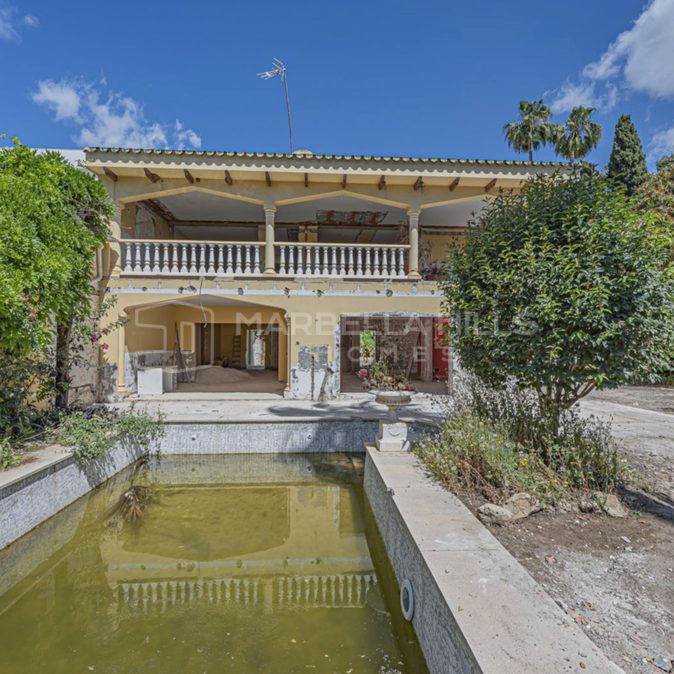
Villa for Sale on Marbella Golden Mile – Private Luxury Home in Nagüeles
Marbella Hill Club, Marbella Golden Mile Reduced from €4,850,000€4,400,000Located in one of the most desirable areas of Marbella Golden Mile, between Sierra Blanca and Nagüeles, Casa Lagos is…
- View Property
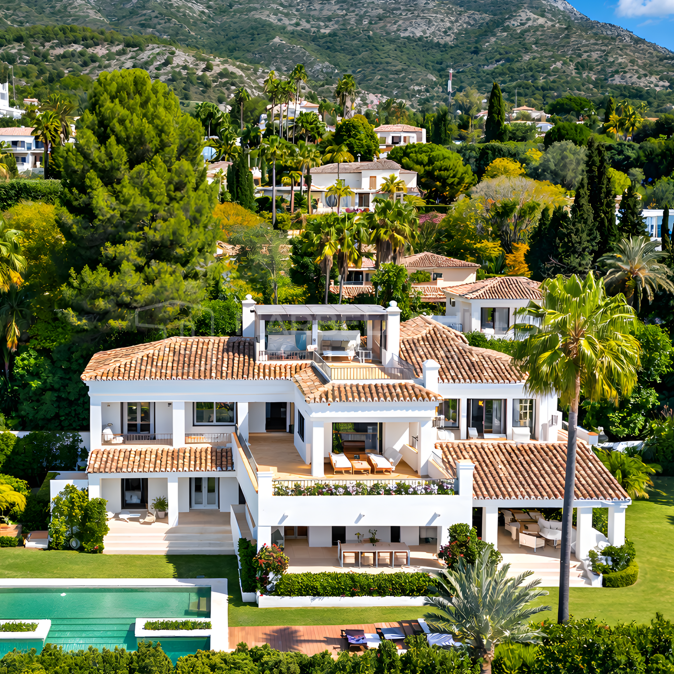
Villa for Sale in Marbella Hill Club – Exclusive Designer Residence near the Golden Mile
Marbella Hill Club, Marbella Golden Mile €13,500,000Located in the prestigious Marbella Hill Club, just minutes from the Marbella Golden Mile, this exceptional villa for sale offers…
- View Property
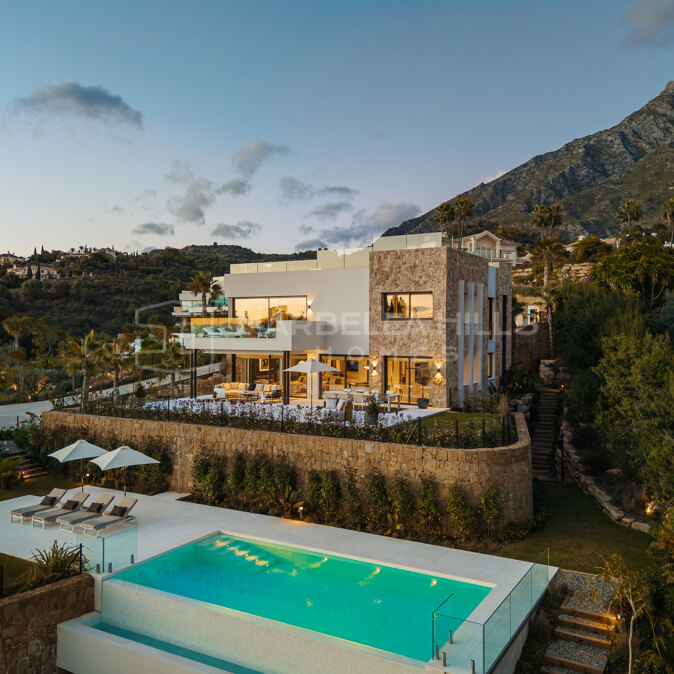
Luxury Contemporary Villa in Marbella Hill Club - Sea View Designer Estate Near Marbella Golden Mile
Marbella Hill Club, Marbella Golden Mile €14,995,000Situated in the prestigious Marbella Hill Club, just minutes from the Golden Mile and the centre of Marbella, this exceptional…
- View Property